
Our New Normal...... Art & Creativity Can Help
It's been quite a while since my last blog...lots of distractions and challenges for all of us. We have and still are coping wth many issues. We've learned to adapt to changes in climate, global illnesses,financial factors and more affecting our families and friends. While staying cautious, we're able to find activities of interest for our kids again... see if there is a talent they wish to further develop or improve.
Think about creative arts (art, music, theatre). These venues offer new skills and increase self esteem as they enjoy sharing like interests with their peers. We encourage exploring new materials and subjects to stimulate their creativity and critical thinking,often leading to amazing reuslts!
Creativity and Learning...
Creativity is central to our humanity; a powerful force unique to the human species. It can be a wonderful energy that enables us to use our imagination to create art, music, dance, writing and so much more. Let’s be honest, when you think of math and science, creativity doesn’t seem to fit into the equation - pun intended, I couldn’t help it.
Creativity and curiosity work hand in hand, each encouraging, inspiring and moving the other along. When the brain is in creative mode, it makes us think about the other possibilities and unknown choices that may be achievable. Possibilities lead
Creativity is central to our humanity; a powerful force unique to the human species. It can be a wonderful energy that enables us to use our imagination to create art, music, dance, writing and so much more. Let’s be honest, when you think of math and science, creativity doesn’t seem to fit into the equation - pun intended, I couldn’t help it.
Creativity and curiosity work hand in hand, each encouraging, inspiring and moving the other along. When the brain is in creative mode, it makes us think about the other possibilities and unknown choices that may be achievable. Possibilities lead...
Read More
Creativity is central to our humanity; a powerful force unique to the human species. It can be a wonderful energy that enables us to use our imagination to create art, music, dance, writing and so much more. Let’s be honest, when you think of math and science, creativity doesn’t seem to fit into the equation - pun intended, I couldn’t help it. Creativity and curiosity work hand in hand, each encouraging, inspiring and moving the other along. When the brain is in creative mode, it makes us think about the other possibilities and unknown choices that may be achievable. Possibilities lead to a need for additional facts, experience and experimentation. It is these trials and experiments that may lead to great discoveries in science, health, education, production of consumer products, etc.. Think back to all the modern conveniences created over the past twenty years. Some created by geniuses, others by everyday people inspired by creative thinking and curious about finding a better way: “Inspiration exists, but it has to find you working”.— Pablo Picasso “When you ask creative people how they did something, they feel a little guilty because they didn’t really do it, they just saw something”.— Steve Jobs “To get a great idea, come up with lots of them”.— Thomas Edison The arts are positive and stimulate creativity because they’re forgiving. They allow for differences in expression, uniqueness and individuality. They may adapt and encourage different approaches to learning. For example when students are learning how to draw realistic geometric form, they are focusing on angles, size, ratio, and proportions. When these elements come up in math in school, they are already familiar with them and open to learning more. The processes used in art overlaps into the sciences: terms such as organic form, mass, vitality; the study of life and nature are discussed as we draw and paint landscapes, animals and solar systems. “A painter told me that nobody could draw a tree without in some sort becoming a tree; or draw a child by studying the outlines of its form merely . . . but by watching for a time his motions and plays, the painter enters into his nature and can then draw him at every attitude . . .” — Ralph Waldo Emerson Mixing colors and different mediums encourage open mindedness and experimenting as students layer their works with various objects. What may start out as a watercolor landscape may they become an eclectic collage full of memories or deeper meanings. This encourages still more thinking: is there anything else that could be added or does something need to be removed (encouraging critical thinking, objectivity and developing an aesthetic eye). These skills will carry over to creative writing and writing structure in general (were goals met, questions answered, details included for support, clarity in message achieved?) “Around here, however, we don’t look backwards for very long. We keep moving forward, opening up new doors and doing new things, because we’re curious... and curiosity keeps leading us down new paths.” — Walt Disney
The arts are venues for communication as ideas, dreams and wishes are created in musical notes, dance steps and words written in stories and poetry. They allow expression in so many ways that may empower a child to feel his or her voice is heard. My favorite quote? “Creativity is contagious. Pass it on.” — Albert Einstein Marlene Bohnyak Owner/Instructor
How does Art Help Us?
Drawing stimulates the brain to grow in the areas that learn how to observe. Some children are born ‘artistically gifted’ and love to spend time more time drawing than others, but these habits can be nurtured and developed in most children. For all children (and adults) art can be used as a means to increase intellectual capacity to observe and express. Art is made of memories, imagination, observations. Memories are the inspiration, imagination helps provide the material for constructing art and observations help the artist make sense of the project, giving it direction and meaning.
Children who routinely practice drawing, painting, building with clay, cutting out shapes for collages etc. often discover
Drawing stimulates the brain to grow in the areas that learn how to observe. Some children are born ‘artistically gifted’ and love to spend time more time drawing than others, but these habits can be nurtured and developed in most children. For all children (and adults) art can be used as a means to increase intellectual capacity to observe and express. Art is made of memories, imagination, observations. Memories are the inspiration, imagination helps provide the material for constructing art and observations help the artist make sense of the project, giving it direction and meaning.
Children who routinely practice drawing, painting, building with clay, cutting out shapes for collages etc. often discover how to make observations and drawings that seem advanced for their age. Drawing and other observational art projects such as collages and collections encourage an eye for detail, awareness of differences and similarities. Drawing strengthens memory and promotes fine motor skills, spatial understanding, better handwriting and manual dexterity. Handwriting and drawing can definitely be improved when correct grip, pressure and posture are encouraged and monitored.
Drawing is the natural and best ‘beginner art’ for young children and can be enjoyed and improved as the child matures. Younger children are less apt to compare their drawings to others and are less self-critical and more tolerant of their own work. While most children benefit by early instruction and practice in observational drawing, not all are ready for instruction. Some may get frustrated when their drawings are not recognizable, and become resentful when help is offered. Show them how help, and practice can make a positive difference. Give them time and try a few months later, eventually most children will accept help. To keep the child's interest going, make it a fun activity with praise for effort.
Children naturally love the arts – painting, drawing, music, the theater. Unfortunately, when schools cut back on budgets, the arts are usually the first to go. It seems that schools do not appreciate the importance of art in building child’s brain. Physiologically, the human brain consists of two parts, the left and right hemispheres. The left brain is used in logical thinking and analytical processes. This is typically what is trained in school work that consists of math, reading and science. The right brain is used in emotional perception, intuition and creativity. It is the right brain that is mainly used when a person is involved in creative endeavors such as making art. Sadly, it is this part of the brain that typical school environment neglects to train.
It is shown that when gifted kids solve problems in their areas of giftedness, there is increased electrical activity in both hemispheres. It appears that for the brain to be efficient, the two hemispheres of the brains must work together. By stimulating and exercising the right hemisphere of the brain, the arts strengthen the connection between the hemispheres. Kids should be exposed to the arts as their cognitive skills mature so that their right brain will be as developed as the left, and both hemispheres work in tandem, thus achieving the full potential of the mind. Give your child a great start - give your child the gifts of art.
Marlene Bohnyak
Owner/Instructor, Artisan Studio
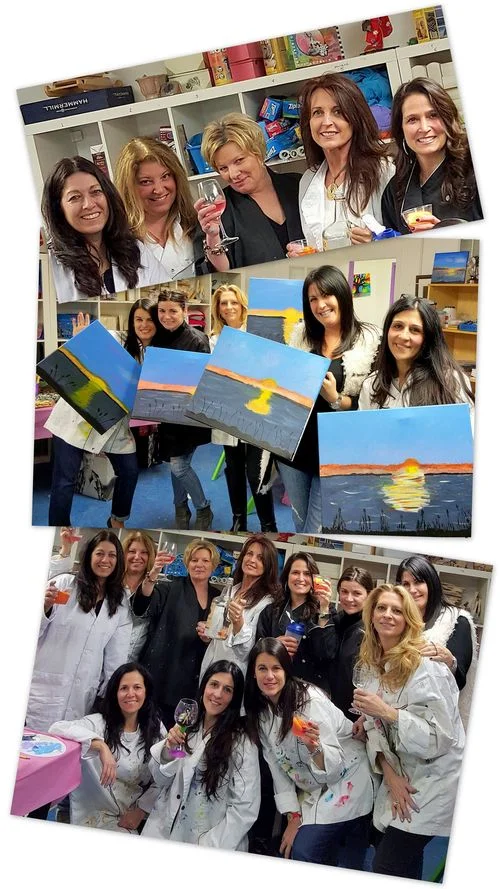
Adult Painting & Drawing Parties
Looking for something different as an ‘excuse’ to get friends, co-workers or adult family members together? A new (and creative) activity for a fundraiser? You may have heard all the buzz about them...or maybe you just went to an adult paint party... they’re lots of fun! PAINTING PARTIES are a great choice....and most importantly you and your guests don’t have to have any talent to participate, just a willingness to follow directions and make an effort to try... you won’t be disappointed!
Looking for something different as an ‘excuse’ to get friends, co-workers or adult family members together? A new (and creative) activity for a fundraiser? You may have heard all the buzz about them...or maybe you just went to an adult paint party... they’re lots of fun! PAINTING PARTIES are a great choice....and most importantly you and your guests don’t have to have any talent to participate, just a willingness to follow directions and make an effort to try... you won’t be disappointed!
Our WINE AND DEZINE parties have been growing in popularity for the past five years: a great way to get friends and families together for a special occasion, or ‘just because’. It’s a lovely way to spend time with the special people in your life while doing an activity that’s fun, interactive, and has great results: a unique artwork to be proud of! ARTISAN STUDIO will be starting it's 14th year in beautiful, historic HOBART HOUSE in the heart of Marlboro. Our instructors are all working artists with degrees in their area of expertise. We love sharing our knowledge of art, passion to inspire others, and enjoyment in the creation of all sorts of visual arts. We’re here to help you explore and enjoy your creative side. Our instructors demonstrate techniques and assist anyone needing guidance.
There is a separate room for food, next to our easel room where the paintings are created. Our parties are private, they are by invitation only, no walk- ins. Guests coordinate the food arrangements: WINE, and other drinks, sandwiches, finger food, chips & dips or other appetizers and of course cake, pastries or other desserts! PARTY DETAILS:Painting subjects: we offer choices of abstract, landscape, still life, animal, cartoon character or other figures. The subject is chosen by the party’s host. Variations are encouraged to make the artwork suitable and appealing to each of the guests.
Click here to book your party or event!
ART…and Homework, Study Habits & Organization
Let’s face it, kids are all individuals, special and unique little persons that we love and care for. After all, adults are all different in so many ways: underachievers, overachievers, mellow or intense personalities, the list goes on and on. When we observe these attributes, we may find there are some behaviors we might like to change to help the child work in a more efficient manner or better organize themselves. Some parents may find that they are looking to de-stress their child or give them a better sense of self, with more confidence, helping them interact with other children in a more positive manner. Look to see where your childʼs interests lie and encourage activities that relate to it. It might be a physical activity such as sports or dance, martial arts, or anything else that involves movement and coordination. The discipline in that activity may be able to transfer into other areas of your childʼs home or social life. Think creatively and see what parallels you may be able to apply in those areas and there may be positive results.
In artistic activities, there are many areas in which your child
Let’s face it, kids are all individuals, special and unique little persons that we love and care for. After all, adults are all different in so many ways: underachievers, overachievers, mellow or intense personalities, the list goes on and on. When we observe these attributes, we may find there are some behaviors we might like to change to help the child work in a more efficient manner or better organize themselves. Some parents may find that they are looking to de-stress their child or give them a better sense of self, with more confidence, helping them interact with other children in a more positive manner. Look to see where your childʼs interests lie and encourage activities that relate to it. It might be a physical activity such as sports or dance, martial arts, or anything else that involves movement and coordination. The discipline in that activity may be able to transfer into other areas of your childʼs home or social life. Think creatively and see what parallels you may be able to apply in those areas and there may be positive results.
In artistic activities, there are many areas in which your child may engage her imagination, motor skills, eye-hand coordination, awareness and personality. She may have a wonderful flair for design and pattern, yet not much patience for the workmanship involved for completion. Your son may love drawing animals or cartoons, but rushes through the artwork in a haphazard manner, although he is capable of much more. You notice the similarity in their efforts to do their homework, home chores or other activities. The good news is that the same skills used to improve their artworks do transfer elsewhere! By engaging in art related activities and projects parents may see the improvement carry over in their childʼs schoolwork, from improved handwriting and neatness, organization, and on to working faster or slower, yet more efficiently.
How does art affect your child? When drawing is taught, there are step-by-step methods used to teach drawing by observation, which enhances awareness, attention to detail and spatial relationships. Using a method to begin work can jump-start a project and have it move along more quickly and effectively, minimizing wasted time. These step-by-step processes can be applied to learning and study habits in other areas that involve systems such as math, spelling and creative writing.
When children are working with paint or pastel, they see they cannot rush or colors will muddy up or run into each other, creating colors that they didnʼt want. Drawing cartoon characters develop freedom to go out of bounds and be weird or silly, yet to repeat successful drawings of that character develops restraint and mastery. Detail and proportion are critical to achieve a likeness. They learn that control and patience can be achieved and give them the results they want. This can be applied when they check their spelling or keep their columns in line in math.
Three dimensional art literally encourages thinking ʼoutside the boxʼ using diverse materials and learning how to construct and design both aesthetic and structural balance. Increase in patience and hand-eye coordination are applied here. Clearly, building and fitting pieces together cannot be rushed in an effective assembly, so the child must develop a sense of patience and system as there is a sense of order to the process.
Acceptance of mistakes and encouragement to retry are also extremely important for a child to understand in developing self confidence. This can relate to mistakes in judgment in many areas both inside and outside of school, and used as a great learning tool in many areas. Learning to pause and think things through before taking action will show them improved results. Let them create and reap the many benefits that go along with creativity!
Marlene Bohnyak Owner, Artisan Studio